What Is an AI-First Operating Model? (And How to Build One)
An AI-first operating model is a company-wide framework that redesigns how work gets done – not just where AI tools are added. It treats intelligent agents as a permanent, structural capability rather than a feature layer on top of existing processes.
AI-First vs. “Doing AI”: What’s the Real Difference?
Most organizations claim to be adopting AI. They’ve deployed chatbots, bought enterprise licenses for LLM tools, and run internal pilots. But very few have changed how work actually gets done – and that’s the entire gap.
Using AI means integrating tools into your existing workflows. Being AI-first means redesigning those workflows from the ground up with the assumption that intelligent agents are always available.
The strategic question shifts from “Where can we use AI?” to “How does work change if AI agents are always on?”
According to Deloitte, only 34% of organizations report using AI to drive broader business transformation and innovation, while most remain focused on improving existing processes and efficiency gains. That gap represents a significant opportunity for organizations willing to rethink how work gets done.
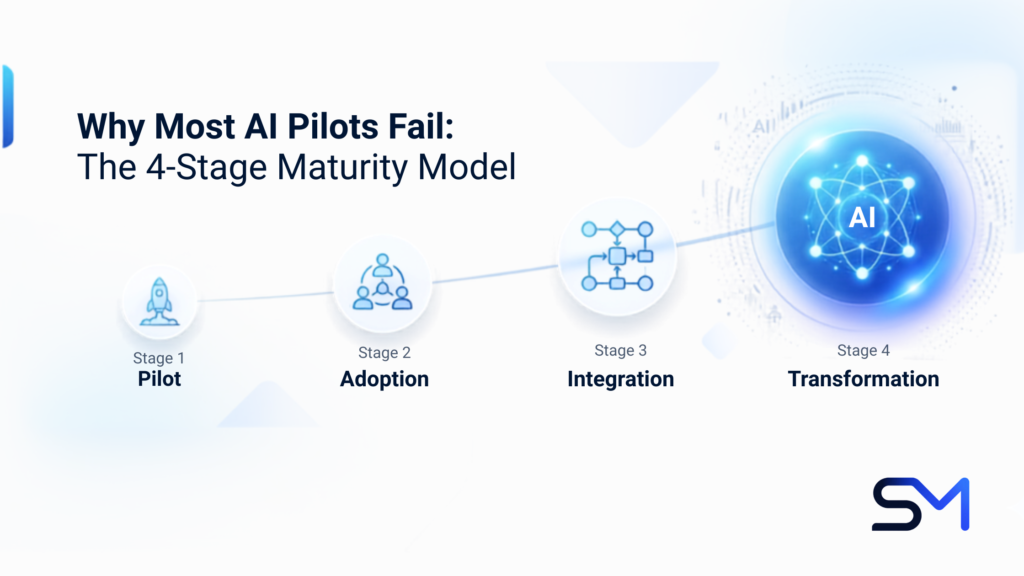
The AI Operating Model Maturity Path
Transitioning to an AI-first operational structure is not an overnight switch. Organizations progress through four distinct, sequential phases of structural maturity:
Adoption
Integration
Operations
Why Most Enterprise AI Initiatives Stall
The pattern is consistent across industries. Pilots launch with internal enthusiasm, then quietly sunset within six to twelve months.
The root cause is the same in every case: AI scales whatever architecture you already have.
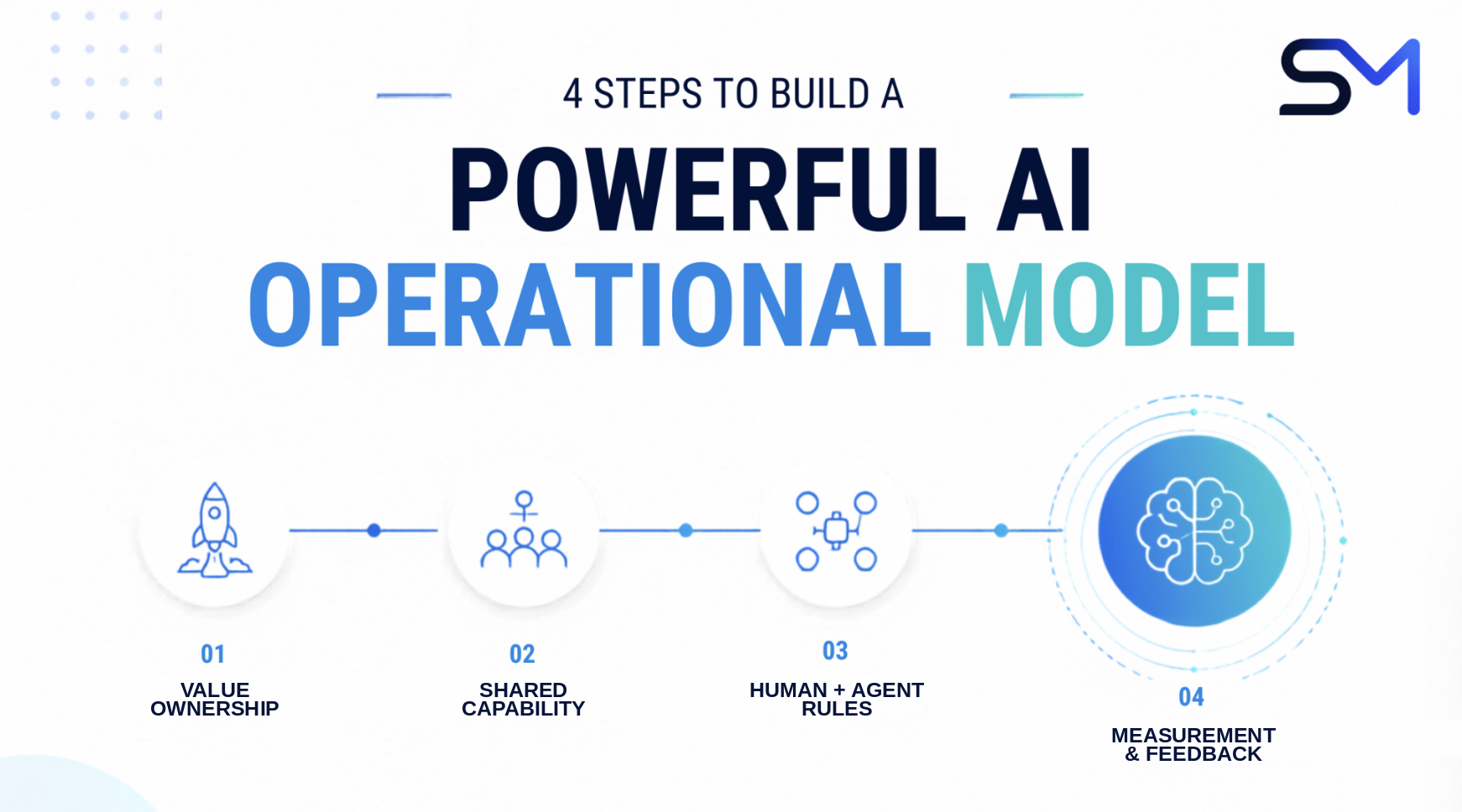
The Agent-Ready Enterprise Model: 4 Core Building Blocks
To prevent pilot stagnation, enterprise leaders must transition from fragmented tooling to an integrated framework. We call this structural baseline The Agent-Ready Enterprise Model.
Value Ownership
Map end-to-end transactional paths and assign outcome owners accountable for business results rather than individual features.
Shared Capability Layer
Centralize identity controls, data pipelines, compliance policies, orchestration monitoring, and deployment standards.
Human + Agent Collaboration
Deploy autonomy in layers: Draft Mode, Suggest Mode, Execute with Approval, and Execute with Audit Logs.
Measurement & Feedback Loops
Track business outcomes, execution quality, and risk continuously to create a self-improving automation system.
Stable vs. Unstable Baseline: The Performance Gap
| Operational Vector | Stable Baseline | Unstable Legacy Baseline |
|---|---|---|
| Data Schema Integrity | Normalized data with strict validation. | Duplicate records and missing fields. |
| Process Execution | Funnels enforced globally in CRM systems. | Pipelines managed locally in spreadsheets. |
| Deployment Horizon | Measurable value within weeks. | Agent abandonment before value appears. |
| Net Strategic Yield | Accelerated throughput and expansion. | Initiatives quietly sunset. |
How to Build an AI-First Operating Model
Case Study: Rethinking B2B Onboarding
To appreciate the divergence between merely using AI and executing an AI-first operating model, look at how a global logistics enterprise transformed its client onboarding operations.
Account teams manually extracted data from custom client contracts to match them with regional warehouse inventory management schemas. The process relied heavily on localized Excel workbooks and took an average of 14 business days. Early attempts to “use AI” involved giving reps access to an unintegrated LLM playground, which resulted in data format hallucinations and a 0% change in time-to-value.
The Shift to the Agent-Ready Enterprise Model: Instead of treating AI as an assistant, the company consolidated its contract ingestion into a centralized data pipeline with a strict structural schema. They built an autonomous routing loop using an orchestration agent operating in Execute with Approval mode.
The Impact Metrics:
| Metric | Legacy Baseline | AI-First Infrastructure |
|---|---|---|
| Onboarding Cycle Time | 14 days | 2.5 hours |
| Manual Processing Volume | 100% of accounts | 8% (Exception handling only) |
| Data Cleanliness / Sync Error Rate | 11.4% secondary friction | < 0.5% due to upstream enforcement |
Key Lesson: The project didn’t succeed because the LLM got smarter; it succeeded because the underlying process constraints were completely formalized, giving the intelligent agent a predictable sandbox to operate within.
Strategic Deep-Dive: Frequently Asked Questions
Closing Thought
Being AI-first isn’t about replacing people. It’s about designing work for a world where intelligence is always available – then building the systems, teams, and trust to use it well.
Companies that win with AI won’t necessarily have better models. They’ll have better operating systems. The competitive advantage shifts from intelligence creation to intelligence orchestration.
Want Help Building an AI-First Operating Model?
Evaluate your workflows, identify architectural bottlenecks, and build a roadmap for scalable AI adoption.